Wednesday, 24 July 2013

Sigbjørn Bratlie: Igloos in Thornton


Sigbjørn Bratlie: Igloos in Thornton

Clare Nadal writes
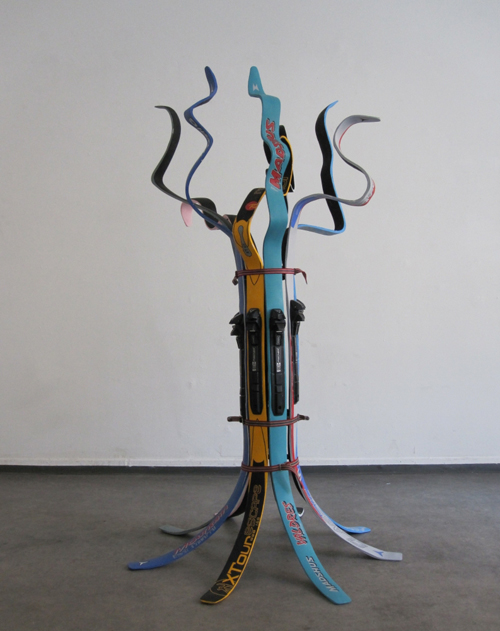
 
Meltdown by Sigbjørn Bratlie
Back in June we announced the exciting news that for the first time ever our summer residency would feature an international artist, Oslo born Sigbjørn Bratlie. I took some time to speak to Sigbjørn find out a bit more about him, his artistic practice and his hopes for this summer project.

When South Square was constructed in 1852 it was originally designed as twelve adjoining cottages to house the local stonemasons as they worked on the now famous Thornton viaduct. The annual South Square summer residency celebrates this heritage by once again becoming a home, and offering the gallery as a live in space for an artist in residence. In 2011, Alfie Strong became the first artist to spend the month of August living and working within the gallery, choosing to live in a tent within the space, whilst creating artwork in response to the gallery’s past and our connection to it.
 
Alfie Strong in residence at South Square Gallery
Taking this context for his starting point, Sigbjørn will spend his residency period constructing a house-like structure, considering what it is to layer a house within a house. However, in his typical humorously whimsical and mischievous way, Sigbjørn doesn’t want it to be a recognisable English house that he builds, but a realistic white wooden igloo. Having worked for his uncle’s interior decorating and carpentry business for over eleven years, he has the technical skills to realise this aim. The project forms a perfect opportunity to incorporate these practical skills into his art practice. 

He says to me, I wanted the structure to be a slightly absurd one; I like the idea of building an impossible house, to invent a type of traditional living that doesn't exist, and maybe doesn't even make sense. The wooden igloo project is kind of crazy, which I like about it.
“I want to present it as ancient lore, the age-old tradition of Norwegian wooden igloo-building; that I am the representative of some tradition-bearing institution. Obviously I know I am fooling no-one: everyone in Britain knows that there are no igloos in Norway. But I intend to play my role with conviction!”

In this way, Sigbjørn’s project will have a performative element as he creates an extensive fictitious setting within the gallery space, surrounding his wooden igloo.  This is a technique he has used in previous projects, specifically his 2007 installation Vanlagnad ('sad destiny') at Galleri 69 in Oslo, which saw the gallery transformed into the home and workspace of a fictitious Norwegian poet. 

This show was an attempt at creating the antithesis to contemporary popular culture: the home of a traditional eccentric Romanticist poet, living by himself, removed from civilisation, churning out lyrical observations on nature, animals and the imagination.
 
Vanlagnad Galleri 69, Oslo (2007)

Vanlagnad Galleri 69, Oslo (2007)

All Apologies UKS, Oslo (2008)
To make the fictitious setting complete, Sigbjørn even took the time to write the poet’s complete works, which featured around 400 short poems, written in an archaic and partly incomprehensible Norwegian dialect. Surprisingly enough however, during the entire exhibition, the poet himself remained “mysteriously absent”. Visitors were able to occupy his living space, sit on his chairs and bed, put their cigarettes out on his floor, and read the paper sheets of poetry which lay scattered all over the place.

A follow up event at The White Tube, Oslo in 2008, in collaboration with Arne Langleite, featured a fictitious book launch of a fictitious collection of Romanticist poetry, published by a fictitious Norwegian publishing house.

Båt på land The White Tube, Oslo (2008)

Sigbjørn's South Square residency is titled My Wooden Igloo, a purposely simple, childlike title that reflects the humour always embedded in his art. Drawing on 'luftstott', the Norwegian word for 'pipe dream', this references Sigbjørn's notion of 'the artist as anti-hero', a concept key to his creative practice. This 'anti-hero' figure is one who desperately tries to create ground-breaking profound work, yet most often fails miserably, inspiring an absurdist humour.

As Sigbjørn points out to me, constructing an intricate structure like an igloo is not easy, "it may be that the igloo ends up being just a tad wonky and askew, but I think that adds to the charm of the project." Likewise, a dramatic irony exists in the knowledge the viewer possesses that this age-old tradition of Norwegian wooden igloo-building is in fact hollow and non-existent.

Sigbjørn's projects, whether installation, painting or performance, are always a humorous comment on contemporary culture, art history and theatricality, and often tend to influence one another. His most recent residency in Latvia, has involved him spending a month working with a local theatre company to learn the famous 'To be or not to be' monologue from Hamlet - in Latvian - and create a video piece from this. Like The Wooden Igloo, the finished video work will be an ode to creative and literary genius, undercut by the knowledge that Sigbjørn (and many other non-Latvian speaking viewers)
will be entirely unable to understand the true meaning of the piece, in many ways making it quite meaningless.

The Wooden Igloo is open from 3rd August until 22nd September. A closing event will be held on 20th September, open to all. I shall be blogging during the two-month residency period so look out for further updates from me on what is happening in the gallery.


Wednesday, 3 July 2013

South Square Gallery Curatorial Traineeship: June Update


South Square Gallery Curatorial Traineeship: June Update

Clare Nadal writes


Summer finally being with us (well a summer of sorts), the leaves beautiful and lush on the trees outside the office window of South Square, I feel it is high time to provide my blog readers with an update on the progress of my Curatorial Traineeship.


Curatorial Development

After the excitement of painting the gallery walls a beautiful muted blue and meticulously arranging beautiful pastel ceramics for David McLeavy’s show home/flat Villa, I had only a short space to breathe before I began my first placement at The Hepworth Wakefield.

Feeling a conflicting mixture of nervous expectation and excitement, I began my first two week placement. I joined the Collections and Exhibitions team for the de-install of the hugely successful Alice Channer, Linder and Jessica Jackson Hutchins exhibitions and the install of the current Haroon Mirza and William Scott shows.

During the de-install, I was involved with filling in the condition reports for the Alice Channer sculptures on loan to the Hepworth before they journeyed to their next location, checking the sculptures for any changes and damages. Then as the Scott loans arrived I donned my white curators’ gloves and assisted the couriers and conservators, documenting the packaging and checking the condition of the works. This was a real eye-opening experience for me to learn just how much care and detail is involved in conservation.
   
Later in the second week, alongside Holly Grange, the Collections and Exhibition Assistant, I began work on a small archive display for the Scott exhibition. Having never worked with archives before, this was hugely exciting for me, in particular being able to handle and transcribe original correspondence between William Scott and Barbara Hepworth. In addition to assisting with the selection and arrangement of objects and artefacts for the display, I also created a timeline of Scott’s life, allowing me to develop my research skills and increase my knowledge of Scott and his artistic practice. I also assisted with editing the labels for the Scott works and was able to learn the conventions of long and short labels that The Hepworth use.

 
Summer Projects

Back at South Square we are currently working on an exciting partnership with the Bronte Parsonage Museum to commission a new outdoor artwork in the Parsonage Meadow with a sister exhibition at South Square. The new works created will celebrate the local heritage of the area, the relationship between the Thornton and Haworth villages, and the Bronte sisters’ connections to these places. For this project I have been a member of the selection and interview panels, providing me with the exciting opportunity to interview artists and hear them speak about their work, practice and ideas. Both the outdoor artwork and the South Square exhibition will be on display at the time of Le Tour Yorkshire cultural festival, held when the Tour de France comes through Yorkshire in Summer 2014.

Summer 2013 looks set to be an exciting time for me as I spend some more time at The Hepworth, this time in Collections, assisting with the auditing of the collection the gallery is carrying out over the summer period. Last week I began work on this project, receiving training in using MODES, the Museums and Collections Database, as well as art handling and cataloguing. I will also be hopefully assisting artist Des Hughes with some archive research he is carrying out into Henry Moore’s links with Castleford.

I shall also find myself busy with my own research for my trainee exhibition in December as I start to shape and plan my show. Catch up with me in the autumn when I will provide an update on how everything is going and give a taster of what to espect from my exhibtion!

Wednesday, 8 May 2013


Sally Barker: ‘Sticks and Stones’

Clare Nadal writes


Stack by Sally Barker
                  
On a suitably grey and misty morning in March, Artistic Programme Manager David and I drove over the moors to Hebden Bridge to pay a studio visit to South Square Gallery’s next exhibiting artist, Sally Barker, praying that our failure to remember the trusted sat nav wouldn’t cause too much disaster.

I would like to take a moment to describe my experience of the journey, since I feel this is central to understanding Sally’s work…. ‘I find myself am amazed how quickly the green fields and hedgerows of Thornton are left behind and instead we find ourselves high up on eerie, mysterious moorland. It is a different world up here; we haven’t seen snow for weeks down in the valley but up here blocks of snow stubbornly remain, like some otherworldly relic. Then without warning, we suddenly find ourselves dropping sharply down into the steep narrow valley and suddenly we are back in civilisation, fallen down the rabbit hole into the centre of Hebden Bridge. Sally’s home lies up another hidden fork in the valley, again taking us away from civilisation. As we drive up the narrow road I am aware always of trees, dampness and rock, covered in moss and lichens.’

This constantly shifting world is the world Sally self-consciously engages with in her artwork, exploring the interplay of the built and natural environment and our relationship to the landscape around us. As she tells us, she regards her role as an artist “somewhere in between that of a scientist, farmer and gardener.”

As part of exploring human intervention in the natural landscape, Sally is interested in both how we cut into the environment and how we build onto it, physically pinning it down. Consequently much of her photographic work explores images of ruins on the nearby moors, in particular Top Withens, the famous ruin which is popularly thought to have inspired Emily Bronte’s Wuthering Heights.

Contemporary Handmade Ruin at the Hushings by Sally Barker
Reservoirs also feature highly in both her photographic and sculptural work. Sally tells us that she is intrigued by the ability of both of these features to breach the divide between manmade and natural landscape feature. Reservoirs become assimilated into the landscape around them, eventually becoming a feature of beauty in their own right (such as the popular Ladybower, Derwent and Howden reservoirs in the Peak District), whilst ruins tend to become endowed with something of the sacred reverence of a holy relic.
 
The Ice and the Hole by Sally Barker
With such features as these present in her sculptural work, ideas of history, time and fragility are all evoked. Attached to the rough pieces of natural rock that Sally scavenges for in her local quarry are Greek-like columns made from ice and resin. Human presence is implied from the cast body parts she places in her sculptures. These body parts, in particular the delicate nipple flowers and cast heart, bring a sense of intimacy to these works; this is personal artistic expression that the viewer is privileged access to.     


Artmaking is a highly personal process for Sally, both informing and being informed by the course of her daily life. Her house is both home and studio space simultaneously. In her dining room-come-workshop space, dvds share home with sculptures, vases and architectural scaffolding structures sit side by side, and the piano and photographic prints battle for centre of attention. The artist’s studio is not some mysterious distanced and hidden entity, shut off in both physical and metaphorical zones of creative expression, but something integrated into everyday life.


As part of this, Sally continually scavenges for local organic raw and found materials for her sculptural work, often from her very garden. She is always keen to experiment, the process of making being integral to her work. Recently she has been using YouTube to learn how to knit with sheep’s wool and stitch pieces of stone together with steel wire.

Architectural elements are also important to Sally and have featured in much of her previous work and conceptual thinking. Having built The Sally Barker Gallery (2000), a small cardboard and polystyrene model which houses miniature versions of all of her artworks, made on a scale of 1:100, she now has widened her horizons to “world domination”. The Sally Barker Empire is to be the realisation of this aim, a project aimed at encouraging self-promotion and empowerment through architectural hijacking, annexing and the imposition of her sculpture, in model form.

The Empire so far consists of a mix of models, drawings, photographs and postcards: visions of galleries, studios and structures designed and built in Sally’s name to promote her work. Some of these are hi-jacked famous art institutions, subsumed into The Sally Barker Empire, such as Hi-Jack Tate Modern.
Hi-jack Tate Modern by Sally Barker
Sally describes this work as ‘sculpitechture, quite literally models which fuse architecture and sculpture. She is clear to emphasise that whilst this playful connection to architecture exists, her models inescapably remain sculptures ultimately. As she tells me, “I have no desire to ever have them built; they exist as tiny monuments to artistic vision. The intention is to offer total creative license, both with the models and with the ideas they potentially house.”

This exhibition will feature several of her ‘invisible building’ sculpitectures, architectural plan-like structures, made in three dimension out of natural grasses. Housed within are model scale figures, providing an almost utopian vision of a potential future in society and architecture.


Sally is keen for her exhibition to engage with its locality. To this end, she is creating a new body of work that critically engages with South Square Gallery’s stone heritage and history as a series of stonemasons’ cottages. Central to this will be a new photographic work of the famous Thornton Viaduct. For Sally, the viaduct exemplifies many of her conceptual ideas about landscape; rather than seeing it as simply a testimony to historic architecture, she sees it as humans stitching the two sides of the valley together with stone, a bid to negotiate and mark the landscape.


Following on from Villa by David McLeavy, which is currently showing in the gallery, Sally Barker’s exhibition continues South Square Gallery’s summer season of exploring contemporary art responding to space, landscape and habitation. During August and September, the gallery space will once again be offered as a live in studio for an artist to research and produce new work whilst engaging with the gallery visitors.

Sally Barker’s South Square Gallery exhibition opens on Friday 7 June and will run until 28 July 2013